Tuesday, May 30, 2006

The boycott…

Well, it actually passed. NATFHE actually decided to boycott Israel. I don’t really know even how to react to this for frankly I didn’t believe it’ll happen. I fail to understand the logic behind the decision, which appears ignorant to me and the fact that it was done in between discussion on wages makes it even insulting. I try to imagine how it was actually done: “Now, when we finished discussing the decrease in our pension funds, let talk about boycotting Israel and then will come back to the question of our travel expenses since the gas prices have risen…” Do they really believe that this is what will change the situation? That this is what will encourage the sides to find a solution? It seems like a populist and arrogant decision by which someone probably gained some political capital. Here is this decision is counterproductive by the very least. It creates a situation where people are pushed to the ages. You are not allowed to have a sophisticated opinion (support the existence of a separation wall/fence and argue for full withdrawal from the territories for example). You have to take a stand either you are with “us” or with “them”. How useful can it be? Moreover the decision shows the deflation of words we are having around this conflict (genocide, apartheid, ethnic cleansing, etc. are so easy to use these days and yet bear so little of the original meaning), but that’s an entire different issue for another post.

I tried following what is being in media about this and then in blogs. Of course Haarretz covered this both in HE and EN. Also Ynet had an EN publication about this. If you googled boycott in the last two day you could get the whole bunch of articles about the decision. Same goes for Technorati (only there I searched for “academic boycott Israel” – almost 30 posts in EN in the last two days). The reactions in blogs are rather predictable – there are those who only condemn the boycott or only support it (hmm… I think my own post fits this pattern too). There were more blogs who condemned it and just a few that supported it and even fewer that went into any kind of discussion on the topic (either pro or con). As always, the comments are the best part :)

Monday, May 29, 2006

Good news for bloggers…

...though not sure if it is as good for the readers.

Another article in HE Haaretz today (I am stopping with it for my subscription to the newspaper is gong to end in just two days :) told a story of Apple’s loss in a suite where they tried to force bloggers to expose their sources. The court said that it has no tools to distinguish between “legitimate” (read “mainstream and/or established”) and “non-legitimate” (read “grassroots and/or alternative”) news. Thus all the rules applied in order to protect journalistic practices should be applied to blogs as well.

Seemingly, it is a positive development strengthening the blogsphere. At the same time, I think there are question rising as to the parallels between blogging and journalism. When I am writing that, I have in mind the issue of ethical norms. While established journalists are subject to a certain set of ethical norms and rules, are the bloggers subject to same criteria? Should the be? Even when the journalists do not comply with the ethical code, there is scale to assess their activity, but is there such measurement for blogs? And again, should there be? What will stop me tomorrow from attacking a company, an institution or a person, without any basis? What will stop me from spreading lies over the blogshpere? Is there any shared code of conduct here according to which I may check if my actions are legitimate? Or anything is legitimate?

I think I’ll go to sleep on this happy note :)

Following up the boycott initiative.

Here is another article published in the EN Haaretz about the boycott issue. The writer’s position is pretty known in advance (just try googling his name), but, once again, the article proves that reading the comments is one of the more interesting things :)

Also I took a quick look at other Israeli sources covering the boycott issue. There was only one article in HE Ynet and what seems like a simple translation of it in the EN version. Interesting that the title is “Academics resist boycott of Israeli universities”, which is quite different from what Haaretz had (but to be honest, Haaretz dedicated much more attention to the issue – is it a question of how each one see its audience?).

Jerusalem post also had some coverage of the issue. Looking at the comments you cannot stop wondering what a different crowd reads the different papers (ironically, there was someone named Mike Epstein among the commenters :) Apparently the boycott was already supported by Canadian Union of Public Employees. It is a pity though the JP takes money for the archived content, for it’d be interesting to see what they wrote in the previous articles on the topic (apparently they too covered it for some time already).

I couldn’t find anything on the topic in NRG (Maariv), who has on of the most user-not-friendly websites I ever saw… also I don’t think they have an EN version too.

But the most fascinating things happens of course in the blogsphere. I searched for a string “academic boycott Israel” and got 1,079 results in English with any authority. Although there are not that many blogs dealing with the issue (look at this chart) the topic has been discussed pretty much constantly through out the year (at least one post a day I think) with some peaks (one really distinct was at the end of December last year – I wonder why was that?). However, I couldn’t find anything too fascinating there. Just the standard reference to mainstream media publications.

Sunday, May 28, 2006

Tomorrow is the vote for boycott.

Well, tomorrow, the British National Association of Teachers in Further and Higher Education (NATFHE – how do you pronounce that?) is going to vote on the boycott issue. There was an article in Haaretz on this subject, focusing on the efforts to stop the initiative.

Interestingly enough, there is a significant difference between the English and the Hebrew versions of the article. The EN one is much more ‘parve’ I would say, and in this way diminishes the complexity of this situation. For example, the HE version ends with a quote of Prof. Arik Monman from the City University of London, who is actually an activists against the boycott. He says a few things, such as: “For many members of the union the boycott is simply another aspect of leftists activity”. Then he adds that the boycott will actually be a very minor issue at the summit, since the major topic is going to be (surprise, surprise) diminution in the real values of the salaries of the association’s members.

I think quote like this puts the entire idea in a bit different proportion and yet again emphasized my initial idea that people who are actually acting for such action do not really appreciate its importance and complexity. In a way it reminds me all the early anthropologic studies when (frequently British :) researchers even didn’t leave their comfortable armchairs writing about the aborigines and the native societies from a pretty arrogant perspective (or when they did go, it still was a patronic attitude towards their subjects – because the developed world knows much better what is good for you) … History tends to repeat itself, and it is interesting to find yourself in a position of an aborigine…

Monday, May 22, 2006

Academic boycott

A few days ago I read about the renewal of an academic boycott on Israel by the British academics and I fail to follow the logic of it. Not only it attacks the sector which probably holds the most liberal views and is promoting a leftist agenda, the argumentation provided is so lousy, stereotypical and blindfolded, that it crates an obstacle by itself towards any kind of dialogue. There was an article in the Hebrew version of Haaretz today, which made me wonder, how many of those who so passionately advocate such boycott (it is already the second large scale attempt) do really understand what is going on here? Is any idea, articulated strongly enough able to carry away even the very intelligent groups of European academics without trying to go into the depth of it? Weird feeling… Still thinking about it…

First we took Ashdod, then we took Tel-Aviv…

… (and probably Neve Elan too)

Just a short remark, trying to keep the blog alive. Yesterday I discovered that the Israeli channel 10 has simultaneous voice-over translation to Russian. That was pretty weird watching it, but nevertheless interesting. Of course I run to check the leading Israeli TV channel, channel 2, and their news didn’t have any translation.

Have no idea what to do with this info yet, but I was fascinated…

Tuesday, February 28, 2006

Anoter brick in the IG debate...

An interestsing article i just got through Cyber-Society mailing list:

US: Tollbooths on the Internet Highway

by Editorial, The New York Times
February 20th, 2006

When you use the Internet today, your browser glides from one Web site to another, accessing all destinations with equal ease. That could change dramatically, however, if Internet service providers are allowed to tilt the playing field, giving preference to sites that pay them extra and penalizing those that don't.


Continue reading...


On another note, here is a link to an article which Leonichka sent me today:

The Credible Threat.
Dr. Michel Geist
Feb. 28/06

...Starting tomorrow, China's Ministry of Information Industry plans to begin offering four country-code domains. In addition to the dot-cn country code domain, three new Chinese character domains are on the way: dot-China, dot-net, and dot-com. As the People's Daily Online notes this "means Internet users don't have to surf the Web via the servers under the management of the Internet Corporation for Assigned Names and Numbers (ICANN) of the United States." In other words, the Chinese Internet becomes a reality tomorrow...


Continuing the search engines theme...

There is an apparently interesting workshop on the subject is going to take place in June in Berlin. The title is: The Rising Power of Search-Engines on the Internet: Impacts on Users, Media Policy and Media Business.

A PDF with further information can be found here. I would really like to see the proceedings of such an event...

Wednesday, February 22, 2006

The future of mobile :)

Just got this video by e-mail... Nothing like laughing on technology. Enjoy! :)

Tuesday, February 21, 2006

Google is coming! So what?

It is a bit weird to write what I am going to, using Google's platform. This is something I'll have to think about… But anyway… If you read "Haaretz" today, you are certain that it is a very big, even historical, date – Google is coming to Israel! Or as it was also phrased: "Google is coming to take its share of the Israeli advertisement market".

Actually Google announced opening of an Israeli branch a few months ago, but yesterday they held their first ever press conference here. "Haaretz" dedicated four(!) pages covering the event and looking on it I couldn't help myself but wondering why?

Except for the fact that the articles recycled already known information about Google again and again, it focused on the (already existing?) tension between Google and the institutionalized advertising. From a title like: "Google is coming to take its share" (EN version) you are getting a sense that Google will revolutionize the advertising industry in Israel - no more and no less. The veteran advertising agencies are shaking from the thought that Google will push them off the market making them irrelevant. Another article, was titled in Hebrew: "The advertising agencies are sending Google a clear message: if you want to make money – work with us" (EN version). Reading that I remember the “offer he couldn’t refuse” from the “God Father”. The most amusing statement quoted was by Yanon Landenberg of "Ideologic". He explained how important the established advertising agencies are, for (only?) they have the knowledge that will allow an effective match between search terms and advertising-worth results. Another article, by Eitan Avirel (EN version), explained how revolutionary Google's entry is for it will make advertising more transparent (and thus more cost-efficient) for the advertiser.

And again, reading all the articles, I couldn't help myself, but thinking what the all fuss is about. Maybe I do not understand something? Particularly being kind of an Internet junky, how come I fail to appreciate the great revolution happening in front of my eyes? Somehow these thoughts reminded me of the times I worked in a VC during the bubble days. I had the same, "dumb" questions back then, but I didn't dare to sound them thinking that I lack the experience to see the entire picture. Thinking back, the naïve questions I had were in place, so now I am trying to raise them again even if only in a blog. Moreover, today I do have a bit more experience to be able to put things in proportion, which again urges me to ask these questions.

The first question rises about the "revolutionarily effect" of the model. There is no doubt that Google's Adword and Adsense are interesting models for online marketing and they apparently work. However, to claim that they revolutionize online advertisement is an exaggeration in my eyes. The entire branch of online advertising is no more than a decade old. During that decade we all could see that simply copying offline advertising strategies online doesn't work and since then the industry was looking for workable models (actually not only in advertising). The process is accompanied by consciously, and I think to a great extend artificially, encouraged hype around the online advertising. The veteran advertising agencies continued playing the same game online trying to lock the web's profitability on them, just as it worked with television (thinking about it, this idea is pretty similar to what Schiller is saying). However, no equilibrium was reached yet, and the industry is still looking for workable models. But the media seem to enter the bubble mode again and comparative institutionalization of the dot.com industries gives more fuel for an exaggerated coverage of every sign of normalization. So, how can you revolutionize something that was not established yet? There is no such a things as an established online advertisement industry yet, so what is the contribution of such coverage?

At the same time it seems like the shake of the dot.com bubble was so strong that the related industries are looking now for some kind of tranquility which will allow them making money without too much crises. Isn't this discourse similar of an "austere strategy" when the industry with the help of media is hiding its head in the sand refusing to learn the trends and adjust to changes? Google has found one profit model that works in the new industry and this is great. Shouldn't this be learned, applied and further developed? In my eyes these are rhetorical questions and I do have unhealthy flashback from the early 2000's thinking about this.

Another point helping to put things in proportion is thinking about the relative size of the online advertisement compared to the total size of the industry. According to various news reports online advertising in Israel accounts for 5-7% of the entire share of the advertising industry, which is estimated around US $805-859 millions. Although it enjoys the fastest growing rates (around 60-70% in 2005), how can it endanger (or revolutionize) the established advertising agencies? Is it me, or the entire issue is way blown out of the proportion? Add on this a very simple fact that only about half of the Israeli population has access to the Internet and you see yet another question mark on the issue of Google-revolution.

Regardless to what is said above, I had another thought I couldn't shake off. It was a great similarity of the treatment Google's opening got and that gained to the visit of Bill Gates a few months ago. Is Google already the next Microsoft? Or it is only in the eyes of the newspapers? Or one particular newspaper? Anyway, I put the paper aside with a weird and unpleasant feeling…
::::::::::::::::::::::::::::::
23/02/2006: Hebrew, edited version of this post was published today in online TheMarker. TheMarker is the economic branch of Haaretz. You can find the article here.

Wednesday, January 25, 2006

(Don't) Do no harm...

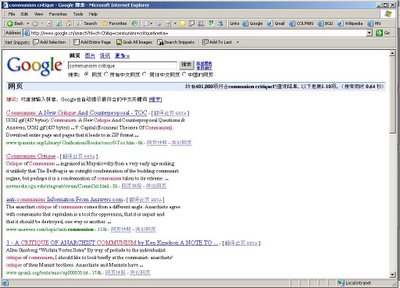
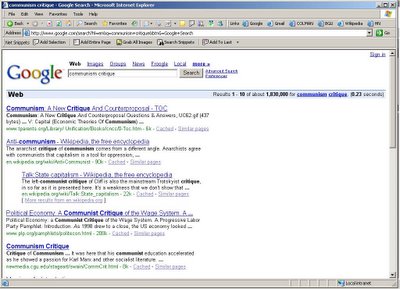
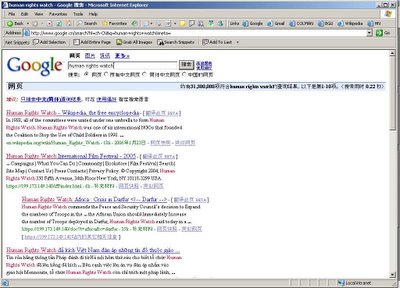
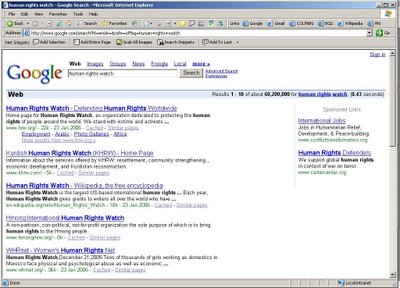
Just read in Hebrew Haaretz about Google's recent agreement with Chinese government. The results from google.ch are going to be monitored and censored. So much for ubiquity of the Internet and the "embedded" freedom of speech...

Couldn't help myself but try :)

Search terms: communism critique
(google.cn: 1,020,000 results / google.com: 1,760,000 results)


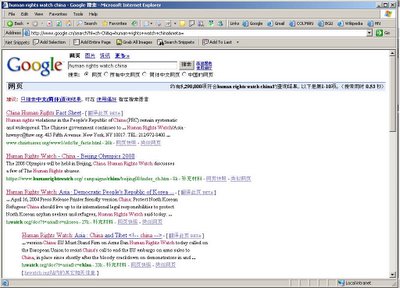
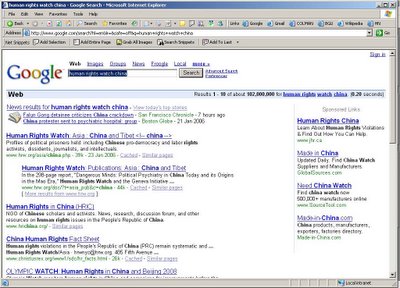
Search terms: human rights watch

(google.cn: 55,600,000 results / google.com: 55,700,000 results)

And a bit more complex one: human rights watch china

(google.cn: 12,800,000 results / google.com: 103,000,000 results)


And now checking the e-mail i came over another today's article featuring the same topic in Guardian. I tried searching for "Tiananmen Square massacre", which is mentioned in Guardian as a forbidden search, and i got some results. Actually the first page results were pretty much the same at both google.com and google.cn. The mainly apparent difference was in the umber of results (281K in .com and 158K in .cn), which i think was also shared by the previous searches (for some reason in all searches at .cn the number of results was lower compared to a similar string at .com).


However, it seems to me that the fact that i got results for supposedly forbidden strings, might be dependent on my IP address. A few months ago some of my friends and i did a small experiment searching google.com for the same string, but from different locations (Pakistan, Brazil and Israel). Not surprisingly we got different results. Makes you think...


:::::::::::::::
28 Jan 2006: I am sorry, just noticed that you can't really enlarge the screen-shots, so they are not really readable... Well, the point is that filtering works :)

22 Feb 2006: I edited this post once again. Added links from the screen-shots to the actual search results (from today of course) and also the number of results per search term on each site.

Tuesday, January 24, 2006

A note on WSIS (before I completely forget)

Well, it's been so long since I've wrote anything here. I keep on putting aside ideas for future posts, but not getting the time to actually write them. Looks like I have to learn making shorter posts more frequently :)

Anyhow, the WSIS topic is left somehow open from my previous post and what I wanted to do is to put a temporal stop here.

It seems to me that the de-facto main issue of WSIS is left undecided. There was no decision on the structure of Internet governance and it seems like the decision was not to decide. Unless I miss something critical here, the decision not to decide means the US point of view prevailed. The web is left to evolve within the current set of rules and governing bodies, with a committee established to think about the future. However, I am left with a feeling of ambiguous ending for the summit. I do not see what were the practical outcomes, either in the original (development) or the emerged (governance) tracks. Or maybe nothing practical was supposed to come out of the summit? I am confused...

Tuesday, November 15, 2005

As WSIS approaches...

Yes, as WSIS approaches, I start getting more and more e-mails and articles about the issue of internet governance. As was stated in ZDNet's article: "The three-day summit - originally organized to brainstorm ways to bridge the digital divide in developing countries - has morphed this year into a contentious debate over who should control key portions of the Internet." Which really links to Lisa's comment to my previous post about politics involved in the process.

However, at this point, I just wanted to share with you a few articles that I got today, for I don't have the time to comment in length about it now. The first article is the mentioned above piece from ZDNet UK about the violence between the government and human right activists in Tunisia prior to the summit. The second article from spacewar.com (didn't have the time to check the origins of it) and it is yet another debate about the internet governance issue (I believe we'll have more on this issue). Another interesting article is from news.com.au and it nice, brief summary of the two major positions over the issue (note to myself – read more about the European proposal). The last, but not the least, for now is a view from Indian perspective on the issue of internet government, but even more than that on the (unjustified?) shift from the original focus of the summit on real problems to the issue of “who owns the internet”.

Shall keep on tracking the developments...

Monday, November 14, 2005

The bloggers' silence as a metaphor

It seems that I am not the only one that is being confused with the silence of the online community about the issue of internet governance. Here is an nice summarizing article about bloggers' (absence of) coverage of WSIS and internet governance. I have no idea what "National Journal" is and the article's title takes a firm stand on the issue ("The U.N. As A Threat To Online Speech"), I think it can be treated as a nice resource on the issue. Moreover, it seems that the bloggers' silence is just one example of online silence.

Another good resource about the issue may be the ISOC's internet governance page. It has lots of links to documents and websites dealing with the issue, however they are very technical in my eyes.

More resources are welcome...

More thoughts on internet governance

Continuing the issue of internet governance, you may find it interesting to read this article by John Markoff (but only if you have a subscription to online version of NY Times, I got it through one of my mailing lists).

The article argues that centralized governance of the internet is virtually impossible and that the argument over Icann is shifting the argument to the wrong direction. Here are a couple of quotes:

The network designers believe that the very structure of the Internet makes it anathema to the top-down control that governments have traditionally exercised over earlier communications networks.

Unlike centralized networks with a single point of failure and control, the Internet was designed to suffer damage and continue to function. That same quality makes it exceedingly difficult to control or filter.

"The idea of Internet control is an oxymoron," said Robert Taylor, who as a director at the Advanced Research Projects Agency in the Pentagon during the 1960's initiated the development of the Arpanet.


"Everyone seems to think that the D.N.S. system is a big deal, but it's not the heartbeat of the Internet," said Leonard Kleinrock, a computer scientist at the University of California, Los Angeles, who did pioneering research in data packet switching, the fundamental technique underlying networks. "Who controls the flow of the ocean? Nobody controls it, and it works just fine. There are some things that can't be controlled and should be left distributed."


Although the ocean metaphor is nice, I find a difficulty accepting it. Unlike oceans, Internet is a human, technological invention and as such, it would be really problematic if there was no way to control it. Particularly, when we talk about 13 root domain servers that construct the backbone of the internet, the political argument over the physical control over them becomes more understandable (at least in my eyes). Thus, arguments such as:

Icann was founded with the intent of becoming an independent or "denationalized" group. But in June, the Bush administration backed away from that plan, saying in a "statement of principles" issued by the National Telecommunications and Information Administration that the United States had the right to maintain oversight of Icann indefinitely.


Are really worrisome. Last year I was at a conference dealing with tools to “fight terror in the internet”. Its main focus was on data mining and online surveillance tools. Pretty horrifying for social science person. However, most of the ‘solutions’ presented were still dependent on local legislation, which didn’t imply global threat from the US intervention. What I am trying to say is that maybe the system is not perfect and there is great room for improvement. Moreover, as you could see in the Kofi Anann’s article I sited in the previous post, the main official motivation behind the proposal to change the current system is developmental. However, when you read a phrase like:

In recent years, Icann has become a lightning rod, focusing opposition to American political and economic power. A group of countries, led by developing nations like Iran, China and Brazil, has put forward a range of proposals calling for Icann's management to be made international; most call for a shift to a group like the United Nations.


you come to doubt that the main motivation is bridging the divides between the developed and the developing world. Neither Iran, nor China, excelled in promoting the personal freedom of their citizens (unless I am really deeply in false consciousness).

Well, maybe it’s just me being paranoid, but the debate over internet governance really bothers me and I am skeptical of the embedded durability of the system against centralized control. Although the internet has a seemingly grassroots structure and certainly grassroots associated culture, I think it is important to keep it a civil society organized platform, rather than allowing either governmental organization/s controlling it. It seems to me the responsible governments would look for a way to build on the existing system, improving its openness and accessibility by unprivileged groups and societies, rather to look for a way of fitting it to the old-fashioned boundaries (which seems not to work that well anyway – poverty rates keep on raising worldwide). But this is where the politics get in and I wonder what will be the final result…

Another interesting question that comes to mind is what simple people, particularly those who already use internet and utilize it for doing good, can do to express their opinion on the future of internet governance? And if they want to do anything, how can they (dare I say “we”) carry that out? What do the netizents want?

Monday, November 07, 2005

Is Wikipedia that mediocre?

Today Veronica sent me an article where Andrew Orlowski tries to establish a claim that Wikipedia is a temporal phenomenon doomed due to its mediocre quality. Most of the support to his claim he gains from the people running “Britannica” and my question – what would he expect? Would he expect them saying that this is a real threat to their business? Would they acknowledge that there is a potentially good enough source to make their product obsolete?

I haven’t conducted or read any research on Wikipedia (although it exists). Due to my skepticism, at the beginning I used occasionally to compare wiki entries with those of Britannica. Those usually turned to be correct and even richer + having context, which is usually not found in printed encyclopedias (try looking at the debates behind such ‘controversial’ topics as “terrorism” for example). Recently, I meet reference to Wikipedia in academic articles and just a few months ago, I heard a researcher from MIT referring to it as “the best information source these days”. Personally, I tend to use Wikipedia pretty often to get initial idea of new terms (particularly about food :).

Reading an article like this I am getting the same feeling I indicated in the previous post. It seems that there is something new and principally different emerging on the web and the older, established systems are refusing to accept this new ‘thing’. Just today at the research methods class I TA there was a discussion about science and the lecturer gave an example of Copernicus, whose ideas were rejected by the church. They were not rejected purely by some religious verdict. The church had its own scientists who proved he was wrong using the scientific tools/instruments of that period. The basic claim was that if we calculate the speed of the Earth, we are getting some 1750km/h – so, how come we do not feel it? The answer came only a few decades later with Galileo’s findings and today people treat this as obvious without even thinking of doubting it (which is not necessarily good).

Of course there is room to criticize Wikipedia, but maybe as a phenomenon, it is something the current paradigms did not learn yet to understand and/or explain? So the best tactic is to preserve the known and understandable? To feel safe? Do the encyclopedias the only owners of public knowledge?


P.S. Also there were a couple of phrases in the article that were very difficult to leave unnoticed. For example, after spending 5 hours yesterday and 3 hours today in the library, the Tom Panelas’s quote “People who use Wikipedia either wouldn't have done anything before - they didn't go to the library to get the information…” is really offensive. Also, at least the last part of Daan Strebe’s remark: “I think of it only as a reference lacking authority, like the rest of the Web” is quite a simplistic generalization given the number of reliable online sources and academic journals.

P.P.S. I couldn’t find who the people/organizations behind “The Register” are. Anyone can help?

Saturday, November 05, 2005

Flying jet with a scooter license?

Seems like I was extremely lucky today…

It’s been a while since I am concerned with the Internet governance issue. WSIS seems to host an extensive debate on the issue and the coming summit in Tunis is supposed to host the culmination. While the summit presents a great degree of politics into the technological realm (thus making official thing that we already know), the official argument about internet governance is more ideological than anything else. So in the next lines, I’ll try to focus on the ideological realm…

So, today I played with google.news and came across an article from Washington post, where Kofi Annan presents the point of view of UN starting with a-very-comfortable-to-quote:

“One mistaken notion is that the United Nations wants to "take over," police or otherwise control the Internet. Nothing could be farther from the truth. The United Nations wants only to ensure the Internet's global reach”

He continues with:

“For historical reasons, the United States has the ultimate authority over some of the Internet's core resources. It is an authority that many say should be shared with the international community. The United States, which has exercised its oversight responsibilities fairly and honorably, recognizes that other governments have legitimate public policy and sovereignty concerns, and that efforts to make the governance arrangements more international should continue.

The need for change is a reflection of the future, when Internet growth will be most dramatic in developing countries. What we are seeing is the beginning of a dialogue between two different cultures: the nongovernmental Internet community, with its traditions of informal, bottom-up decision making, and the more formal, structured world of governments and intergovernmental rganizations.”


After re-reading the original article three times, I wondered if it was only me feeling uncomfortable with the presented arguments and moreover with the presented perspective of governments running the internet. At the time of writing this post, Technorati has 17 blog posts linked to this article. Surprisingly, all 15 of those I could read, were skeptical to critical regarding the UN intensions. You can view Kenneth Anderson’s post as one of the moderate reactions; others were much stronger phrased.

Since all the blogs above were all in English and most of them were clearly identified as American, I thought to continue looking for additional views and searched for blogs in Russian and in Hebrew. Both searches were not fruitful, but I’ll keep on looking. An extended search brought some interesting results like this and this, dealing with the entire isuse of internet governance, as well as some pages with resources such as this and this (a US advocating NGO). Finally, I managed to find a post talking in favor of transmitting the internet governance to UN.

I shall keep on looking for additional views, but these preliminary results made me thinking why would the netizens oppose a change in current system of internet governance? Is it mere “don’t fix it until it broken”? I think that the answer can be found in the statement of SG himself – the cultural gap between the internet as a phenomenon and the modern politics as we know them.

About a year ago, my friend Sharon and I wrote a paper about the relationships between the civil society and the internet platform. In retrospective, there is one major point missing from our article – the grassroots nature of the internet itself, or as put by the SG “traditions of informal, bottom-up decision making”. The conflict arises when there is an attempt to govern something we yet learned to understand (internet) with irrelevant tools (policies and practices developed prior to the internet). I would say that in a way it reminds the attempts of church to deal with discoveries of Copernicus.

The fact that there is a world summit called to discuss internet related issues with particular focus on who is going to control it, is another fact supporting its extreme significance in modern societies. The governments have discovered that there is something happening that they cannot ignore anymore. Apparently, the culture emerging online makes the governments worry, each for its own reasons, but mostly for loosing control. On the one hand, it is acceptable and favorable to talk about grassroots democracy, flourishing civil society and civil activism. The modern technology allows maximizing all those, creating new forms of organizations and activism (both positive and negative). This doesn’t fit the old hierarchical and centralized models of governance. This leads to fear in the old system. It shakes it… So, what seems to happen is instead of understanding the change and channeling it for mutual benefits, there is an attempt to fit it into known small frames of bureaucracy for we feel more comfortable in familiar environment. This attempt looks like trying to fly a jet with a 50cc scooter driving license – I don’t think it can work.

There is a reason for existence of the civil society. As I see it, the reason is a failure of official governments or the private sector to answer the needs of people (the issue of developing countries brought by Kofi Annan in his article is an excellent example for this). It is an expression of values and personal abilities of individuals, who are willing to change their close environment or even the world. What stands at the basis of civil society are first of all the people. Similarly, even if the technological infrastructure was developed by the military and the academia, the culture of the web is a result of human interaction. This culture seems to be very different from what the world has known. One of the characteristics of this culture is its bottom-up evolution and relatively flat structure (take blogs for example). The other characteristic is the fact that this young culture is populated mostly by young, playing a role in crystallizing their views and perceptions. Can you fit it into a box of static rules and procedures? Can you do it without practically destroying it?

Of course one could claim that in current situation the internet is not a pure civil society realm, but is under US supervision. It seems that the fact that this internet governance argument exists, means that the current system is open enough to allow emergence of a new culture (I am a bit too tired now to continue with explanations and discussion :).

Although I believe this post presents a stand I would like to end it with questions. What am I missing in arguments in support of transferring internet governance to UN? Where the current system is failing on a practical level so it (the internet governance system) prevents the developing countries from benefiting the web? Isn’t getting the internet officially politicized bares more dangers than building on the existing practices and improving them? How do you think this should be settled?

I’ll try to follow up on this and everyone is mostly welcome to comment…

Wednesday, October 12, 2005

AdverBlog

Yesterday I read an article from Economist about how internet has empowered the consumers. I think the basic points are well known: those who can access and know how to use the web have much more useful information for what can be labeled as “critical consumption”. They can compare quality, prices, have better basis for decision making, etc. Makes sense…

On interesting point in the article is mentioning blogs as one of a more trustful sources of information. This is particularly true with some blogs that gain extreme popularity and bloggers who have built a reputation and became kind of point of reference for others. Probably this is part of the “blog-excitement” trend, but it seems like it is also true to a great extend. Well, at least now, as long as blogging remains a grassroots activity.

The question which jumped in the back of my mind however was how long it will remain this way? How long it will take till bloggers will start getting paid for what they write? And how long it will take till they’ll start writing exactly what they are paid for? The article mentioned Microsoft adopting one of the celebrity bloggers “even though they are aware he can one day start writing critically about the company” and google suggest already today commercializing your blog with placing commercial (may sound pretty innocent at this point, but it is just a beginning). What is going to be next?

How long will it take advertisement agencies and PR companies to start employing bloggers in order to promote certain brands? Well, they are already doing it in a way by using forums, talkbacks, etc. Just think about how effective it would be for the cost of a single person salary to crate a point of reference for anything regarding let say cars… All you have to do is simply feed it with recommendations paid for by your consumers and you get the best PR ever. Of course it is open for feedbacks and people can and most probably will criticize bad recommendations, but the pivot will still remain biased.

So, the question is (when) will blogs become AdverBlogs?

Sunday, October 09, 2005

Blog SPAM

It seems like my blog is being spammed even though it has just a few posts... On my first post i got advertisement of a dating site, on the second a blog promoting buying Iraqi Dinnars...

Is there any way to deal with this?

(BTW, what would a blog spam called in one word "spog", "blam" or "blosp"? I tihnk i like the first one...)

News abuse

Yesterday (Oct. 08) there was a terrible earthquake in South Asia. At around 20:00 Israel time, about 1700 people were reported dead in Pakistan, India and Afghanistan. Although it was just a tip of an iceberg compared to what we know about the scope of the tragedy today, the issue naturally caught the headlines all media.

Well, almost…

Before we continue, a footnote about the Israeli TV market. There are 3.5 major broadcast channels in Israel: State owned channel 1; privately owned channels 2 and 10 and privately owned channel 9 which is rather small since it focused on the Russian speaking community. All of them show news, actuality and entertainment programs.

Channel 2 is the leading one scoring for most eyeballs of Israeli viewers and the one which many like to criticize for a really shallow content (which really is shallow). Channel 10 is its major competitor, but it is very young (since 2002) and is still loosing money. One of the recent steps channel 10 has undertaken is buying rights for translation of many sport events, primarily soccer games, which are extremely popular in Israel.

Both channels have supposedly independent news companies, which are (not surprisingly) responsible for gathering and analysis of news. There is a firm formal separation between the channels and news companies. Everything is aimed to separate news from everything else in order to assure maximum accuracy.

Now, getting back to the question mark above, let add another one: what happens when there is a natural disaster with thousands dead and wounded and a game of Israeli national team, which has a slight chance of getting to Mondial? What item should go first? And what item should go first if the game is translated on your channel on the same night?

The news company of channel 10 is usually provides very good news in my eyes. Usually, it seems like they are trying hardier and daring more than the better established news company of channel 2. However yesterday, it looked really bizarre when they started the evening news with a 3 minutes item about the hopeless game and then easily moved talking about the death and distraction in Pakistan (interestingly enough, they also started news 2 minutes before the competitors, but it’s another story).

The news on channel 2 started as one could assume with reportage about the earthquake. I don’t know if they mentioned the game later, but this is less important. What is important in my eyes is the border that is getting crossed again and again between news and program promotions. Channel 2 has its own record of split screen with a soccer game on one half and reportage abut suicide bombing on the other and about opening the news with item about a reality shown at the same channel later that night.

So the question is: where is the red line? I think this time it was really irritating, but surprisingly got no response in other media or any public debate.


(ah, wonders of the media… this is why I find this field fascinating)