Friday, December 29, 2006

New Year's present from Google

Who could imagine i will receive a present from them... but yes, they moved my blog to the new blogger and now i will have to spend some time learning the new features. I am particularly happy about the labels, which are actually the reason why i am writing this post.

OK, now i am back to my paper :)

Thursday, December 28, 2006

Digital Divide and Modernization Theory


I am reading a book called "Approaches to development communication" and one of the chapters, by Jan Servaes and Patchanee Malikhao, is telling the story of theoretical approaches to development, basically starting with modernization, through dependency to more complex and holistic approaches.

Describing modernization, one paragraph particularly caught my attention. Outlining the modernization perspective's focus on economic growth and uni-direction evolution, Servaes and Malikhao write:

"In order to be a modern society, the attitudes of 'backward' people – their traditionalism, bad taste, superstition, fatalism, etc. – which are obstacles and barriers in the traditional societies have to be removed. The differences among nations are explained in terms of the degree of development rather than the fundamental nature of each. Hence, the central problem of development was thought to revolve around the question of 'bridging the gap' and 'catching up' by means of imitation process between traditional and modern sectors, between retarded and advanced or between 'barbarian' and civilized sectors and groups to the advantage of the latter."


And I couldn't pass by the 'bridging the gap' without thinking about the digital divide rhetoric. After all the term itself – digital divide – is based in the ideology claiming that there are the advanced and the retarded in ICT adoption, and that getting more advanced necessarily means being better off. Further reading the chapter and thinking about the link, the notion that the two are really linked grew stronger. And I think there is a caution note for all of doing research in the field, or even more so, working in the field, to treat technology more critically, to remember that technology itself is not the goal, but people are.

As the development thinking seems to be moving forward to more sophisticated approaches, the research and practice related to the digital divide should catch up. I just read another article overviewing the digital divide research since the beginning of the millennium and there is a shift, but it is slow. More on that in the next post. Have to finish the paper :)


-----
In case you are interested, the full citation of the article is:
Servaes, J., & Malikhao, P. (2003). Development communication approaches in international perspective. In J. Servaes (Ed.) Approaches to development communication. Paris: UNESCO.


P.S. Did you notice how the donation bar at Wikipedia jumped from some 300K to 700K overnight? I wonder what has happened….?

Wednesday, November 29, 2006

Only in Ithaca 2

We don't need no cinematography! The story continues:


From: bounce-810576-3539755@list.cornell.edu [mailto:bounce-810576-3539755@list.cornell.edu] On Behalf Of Rhoda Streifer
Sent: Tuesday, November 28, 2006 10:00 AM
To: international-l@cornell.edu
Subject: dog walking exchange

thanks to the individuals who are interested, i cannot read the Chinese or Japanese characters in the response sent to me on Nov 26. if you are still interested, please send your mail in English. i do not have software in a different languages.


...and I am on my way to Hong-Kong.

Monday, November 27, 2006

Only in Ithaca

While i am waiting for the tea to boil, here is an email i got on one of my mailing lists:

From: bounce-799805-3539755@list.cornell.edu [mailto:bounce-799805-3539755@list.cornell.edu] On Behalf Of Rhoda Streifer
Sent: Sunday, November 26, 2006 2:59 PM
To: international-l@cornell.edu
Subject: person to walk my dog in exchange for esl lesson or simply get regular exercise


I have a very wonderful 9 yr. old dog whom i cannot walk anymore due my age i have been tutoring English as a second language for 31 yrs and i am the mother of two grown children. The dog walk would only take from 20-30 minutes and i would go along and "pick up' after the dog.The route is near my home from North Albany St around one to two blocks onto north cayuga and then home. This would be good for a man or woman of any age who would like to get some moderate exercise without having to join a gym for $400/month. also, a pre-teenager age 11 though teenager age 16 might like this job. Please let me know.. you may phone me at 277-7351 or respond to this email. . thanks and hope to hear from you soon.


Only in Ithaca :)

Saturday, November 11, 2006

Peace Journalism and Development News

I am trying to understand this concept of development communication. Right now I am reading a book by Clement Asante called "Press Freedo and Development". Putting in a nutshell my understanding of the progress of the subfield of development communication it has gone from applying a modernization theory to alternative, more reflexive(?) approaches, one of which is development support communication. In a way it is a transition from the strong influences paradigm to a more moderate view – if the earlier approaches talked about communication actually leading developmental processes, the later approaches are talking about communication being part of a more complex matrix of social, economic, cultural and political influences.

One of the terms described in the book is that of "development news". Deriving from a body of research that shows that developing nations are being portrayed by the Western media mostly in terms of catastrophes, political troubles, human suffering and misery, she suggests an alternative approach. Here is how Asante describes it:

"Development news is basically a development-oriented news story that gives a positive image of a country. This news item tries to raise national consciousness, promote national unity and integration, and help to improve the quality of life of the people in terms of provision of health services, food production, community development and alike. Thus, development journalism or communication can be defined as the critical examination, evaluation and reporting of the relevance of a development project to national and local needs. In fact, any news item that tends to focus or highlight any form of social change, development, growth, or improvement in a society or nation falls under the development communication concept." (p. 150)

Well, this normatively charged approach may appear naïve, not rigorous and simplistic. Moreover there is a series of question raising about the journalistic norms involved and the role of journalism as a social institution. Later Asante quotes Narinda Aggarwala (1979) who wrote:

"Development journalism is the use of all journalistic skills to report development processes in an interesting fashion. It may require high skills and hard work but the rewards of this kind of journalism can be tremendous. It could almost lead to the humanization of international news"

And then she quotes Schramm and Atwood (1981):

"By development news, these Third World spokesmen mostly mean "good" news."

Reading all this (and more) I had difficult time accepting the idea that development news is necessarily optimistic news. What about some healthy criticism of the regime, the industry, the civil society? What about media being an accountability mechanism in a democratic (or even semi-democratic) society? There is something intuitively wrong in viewing media as a tool of dissimilation of positive news only.

As the same time, reading this, made me thinking about the concept of "peace journalism", which is also trying to promote a normative stand in conflict coverage. I think that there are parallels, while at the same time PJ has some more advanced ways of conceptualizing its position. The basic argument there would be that as journalists take a normative stand in issues of crime, drugs, sexual violence, etc., they can also take a stand in coverage of conflicts. The important distinction however, is that the taken stand is more of a macro character, rather than explicit support to the parties. Similarly to an overall notion in crime coverage that crime is bad, there could be a notion that in conflict situation, regardless on who is right and who is wrong, the conflict itself is bad. At first, it is rather difficult to grasp, but reading more on the subject you do realize how contemporary media do not take a stand towards conflicts, in a way assuming that conflicts are exogenously imposed and they are there to stay. The claim of PJ is by changing the prism and looking at the conflict itself as a socially undesirable phenomenon can contribute to changing the social mindset as well.

Here I can see a possible link to development support journalism as taking a macro normative stand that the development is good. However it does not imply that from now on developing nations should receive positive and optimistic coverage only. The idea is probably more of a self aware journalism contributing to the shift of social mindset.

Another interesting point which is kind of rising from out PEACE study and in a way from Galtung's writing is that talking about peace, you have to talk about socio-economic development. Galtung is talking about positive peace, which is a motion towards inclusion and transparency not just among societies, but also within the societies themselves. Thus the positive peace includes socio-economic development and inclusion within and among nations, which in turn can strengthen my point about similarities in journalistic treatment of peace and development.

Any thoughts?


Wednesday, November 08, 2006

More on parade

Well, Ynet has a special section dedicated to parade coverage, which is probably signifies the centrality of the issue on the Israeli public agenda.

Election and my privacy paranoia

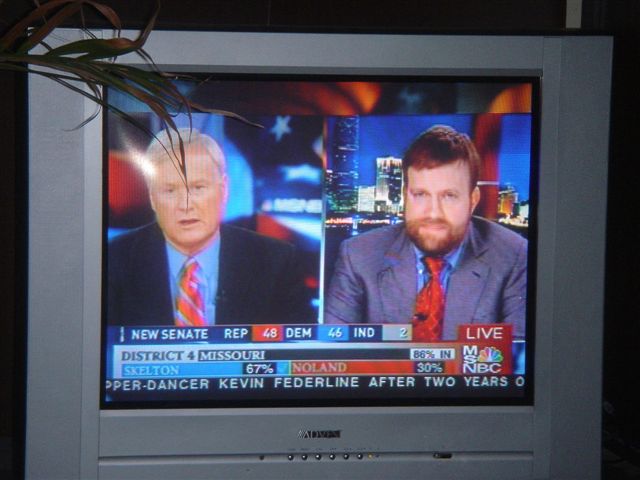
Right now I am sitting in a living room watching, together with two classmates, the results of the US election coming in. Yes, this is yet another socializing event :) As we watch it, there is apparently a mini-history taking place as the democrates are taking back the house. Watching it with two "burned" (literally translation of שרוף from Hebrew) democrats it is rather entertaining. Judge yourself:


more :)

However, not everything is that shiny. A couple of days ago Veronica sent me that article, which was rather "eye-opening" for me. Here are some examples of articles in English describing the phenomena: [1], [2], [3] (thank you Erik for those). Basically, the idea is that in this election campaign managers used voters registry crossed with various consumer data for targeted campaigns. As a result they claim to be able micro-manage the election knowing practically everything about their voters' behavior. So today, when you shop, subscribe for a journal or send your kids to a summer camp, you've been literally monitored by the Big Brother. Is it me, or this is spooky? How come that we don't really care about that? What happened to the boundaries of our privacy? Today the monitor the behavior to target the message/political pressure and what will happen tomorrow? Are we going to be followed to the polls? After that I do start question my concerns about Google for there are worse things out there…

And here is the guy who is apparently (partly?) responsible for creation of this database, Frank Luntz, a name and a face to remember.


Is religion evil?

Well, this is a little bit long one and also probably a sensitive one, but let see…

In the last couple of weeks, there is a huge debate going on in Israel regarding a possibility of having a gay parade in Jerusalem. Well, the parade is scheduled for the end of the week (as from what I understand have happened in the last 5 years), but this time there is a huge opposition to it from the religious communities in the city. The claim, shared by various religion representatives, is that Jerusalem is a holy city and gay relationships are such a huge sin that having the parade will contaminate the place. The things are kind of going out of control at the moment while ultra religious people (dare I say fanatics) are burning trash bins and tires, block highways, throw stones on the policemen and today even attacked the mayor. The police is afraid people will get hurt or even killed. The newspapers seem to be flooded with articles on the subjects and the talkbacks (got to love them!) flourishing with comments ranging from calls to cancel the parade and even expel the gays to having it at any cost and break the bones of everyone who will try to stop it. I also had a big argument with a friend about that matter and we kind of agreed to disagree. But it made me thinking…

The argument against the parade is the holiness of the place. It is claimed that the religious feelings are going to get hurt that much by holding that parade that is not justified to have it. And I keep on asking myself if the religious feelings are more important compared to civil liberties? How do we compare? For example, one argument I heard is that the religion is deeper rooted in our culture, it has history and thus people are more sensitive compared to the gays. Well, first I am not sure how true this statement is. In a similar fashion one can claim that secular Israelis are less passionate about their secularity and thus Israel should be turned into an absolutely religious state based on religious law only. Then, I still find it difficult to decide if a long lasting believe matters more than a basic right of a person to have a different sexual orientation. If I believe for hundreds of years that the earth is flat and it really hurts my feelings when people get out to streets to celebrate the fact that they were able to travel around the world, does it make my believe more valuable than their right to celebrate a different set of believes and behaviors? Another argument I hear is "Why in Jerusalem? Aren't there other places? Why not Tel-Aviv?" And, again, I keep on asking myself, isn't Jerusalem a capital of all Israel? If that is so, why one group of citizens can express their believes and ways of living in the capital, but another is not? How do we decide whose liberties are more important than the others'? Frankly, I fail to see a difference.

I have to admit that the last few weeks gave a lot of food for though about religion, or more precisely what it has became. I do believe the original idea was good, but the contemporary version, or at least the contemporary publicly presented version, is rather bad. For me, the main focus of the last week was of course the debate, or shall I say the fight, around the parade. A few days ago I also read Lisa's post about Australian Sheik Taj al-Din al-Hilaly basically blaming the victims of the southwest Sydney gang rapes, for what happened. I do not understand that.

When I look at religion as it is represented today I see disrespect to women and impatience towards anyone who is different. I see violence, anger and blocked minds. I see abuse of originally beautiful values and I see masses – masses of people who are either being manipulated or have chosen an easy path of being told what to think. This is not kind of a religion I am ready to identify myself with or to support.

Of course, what I am doing here is a rough, and probably unfair, generalization. I've been discussing this with people and many have told that majority of people who believe are not that fanatic. And as a communication scholar I understand that media represent the extremes for they look better on screen. And still I keep on asking myself, why do all those who believe and keep their faith private and pure, do not speak? If they are the majority, how do they allow this bunch of fanatics abusing their religion? How do they allow introducing more evil and anger through this religion that they love and respect? I do not understand that…

I am sorry to admit, but it seems like religion has became a source of all the things we do not want in a modern, moderate, thinking, liberal and patient society. In a ways it has became a source of evil :(

Any thoughts?

P.S. Interesting, looking for articles in English to illustrate some of mine points, I saw that they are actually much more PC than those in Hebrew…

Saturday, October 21, 2006

Wild Ithaca

Well, it seems like since I moved here, the calm town became very wild. There were 3(!) crime instances here in the last two and a half months. However, even when the crime does happen, it is still not very ordinary… Here are two examples from the yesterday's "crime alert" email:

"The Ithaca Police Department is investigating an incident reported to their agency on October 19, 2006, at approximately 5:30 am.
The incident reportedly occurred in the 400 block of E. Seneca St., approximately two hours before the report was made to police. An unknown subject knocked on a resident's door, once the resident opened the door, several masked intruders forced their way into the apartment and demanded money and marijuana. One of the intruders was armed with what appeared to be a rifle or shotgun. The resident reportedly surrendered money and marijuana to the intruders, who then fled."

Maybe that is me, but I find the mere mentioning of the resident surrendering marijuana to the intruders, as part of a police report, amusing. It is ok to hold an armored-robbery-worthy stock of marijuana at home, but stealing it is a crime… OK... But wait! Here is another one:

"The Ithaca Police Department is investigating a trespass complaint that occurred on College Avenue on October 15, 2006. The incident occurred at approximately 5:30 am but was not reported to the police until approximately 10:30 am. A female resident reported that she was awakened by a subject who reportedly was removing her bedroom covers from her. The subject reportedly fled the room when the resident was awakened. The resident fell back asleep. A few minutes later, the female resident was again awakened, by the same subject turning a light on in her room. The intruder again fled when the resident was awakened this second time. The victim described the intruder as an Asian male, in his 20s, wearing a light colored shirt and blue jeans."
And I keep on asking myself: What would you do after being woken up by a stranger trying to pull off your covers? Would you go and check your house? Would you check your locks? Would you call the police? Or maybe just a friend? No, no, no, no!!!! Usually people just turn on the other side and keep on sleeping. That's normal. Happens every day… Unless of course someone turns on the lights - that's wrong!

Tuesday, October 17, 2006

The mystery of the floating bar

A few days ago, Lisa pointed out that my blog was broken. And indeed it was. Now I figured out what it was about. Apparently, Blogger has a really weird feature… when you place a picture which is too big for the post area or a link that is too long, it simply shifts the side bar and puts it down. Nice, isn't it? And apparently there are many people who suffer from this problem. I found this idea on the blogger's help group and simply changed the source pictures for my post about the book sale. The really weird thing is that when I insert the pictures, I give them exact dimensions, so I really don't understand why the size of the source would matter. Any ideas?

Dangerous Ithaca

Here is a message I received a few days ago in my email:

Campus Crime Alert
Oct. 13, 2006

The Ithaca Police Department is investigating a strong arm robbery that occurred on October 10, 2006, at approximately 9:30 p.m. in the 500 block of E. Buffalo St. The victim, a Cornell student, was walking on E. Buffalo St. when she was approached by a male subject. The subject knocked her purse from her hand, picked up the purse from the ground and fled west down the Buffalo St. hill. The subject was described as a male, 5 foot, 6 inches tall, medium to heavy set build, wearing a dark-colored, hooded jacket.

Students and others are reminded to be aware of their surroundings and to walk in well lit areas.
Contact the Blue Light Escort Service at 255-7373 to arrange for walking escorts around campus.

Report suspicious persons on campus to the Cornell Police at 255-1111 or, off campus, to the Ithaca Police Department at 272-3245, or dial 911 in the case of an emergency.
This is the first time I heard of crime in this town. And as it happened (well, almost), they actually sent an alert to the entire campus! I find this amusing. And yes, the university police offers escort services for those who afraid walking alone in dark. Well, after all there was a "strong arm robbery"… first one in two months.

What a dangerous place this world…

Thursday, October 12, 2006

Weather

I was checking the weather for tomorrow, trying to figure out if it is going to rain and look what i saw:


(pay attention to the low temprature tomorrow)

Couldn't help myself from posting this. Now i am back to my home exam.

Tuesday, October 10, 2006

Prelims

I guess those of you who visit this blog from time to time, noticed that I didn't update it for a few weeks. Well, this is a sign that I started the semester and it is rather busy. These days, thanks to Columbus, we are having a Fall Break – 2 days to extend the weekend. But this is not a real break. In the best tradition of the Israeli academia the whole break is dedicated to preparations for exams which are called here "prelims". Some of them took place before the break and some are supposed to be after. The difference between prelims and midterms is that there is only one midterm exam in a class, but there can be several prelims. For example, on Wednesday I am going to receive an exam in communication theory class and there is going to be another one later in the semester.

But let leave the techniques aside and, risking loosing the few readers I have here, let me have a prelim for you. It's an easy one:

What would you do at 5:30 (am) on Saturday morning?
a. Sleep
b. Preparing to sleep
c. Go to take a spot in a line for a huge book sale that opens at 8:00

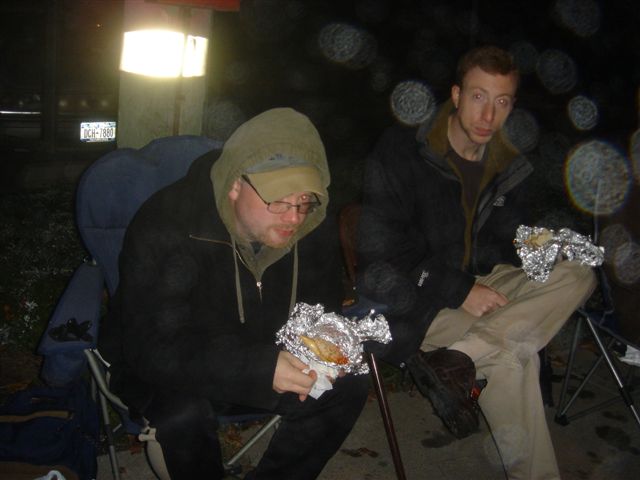
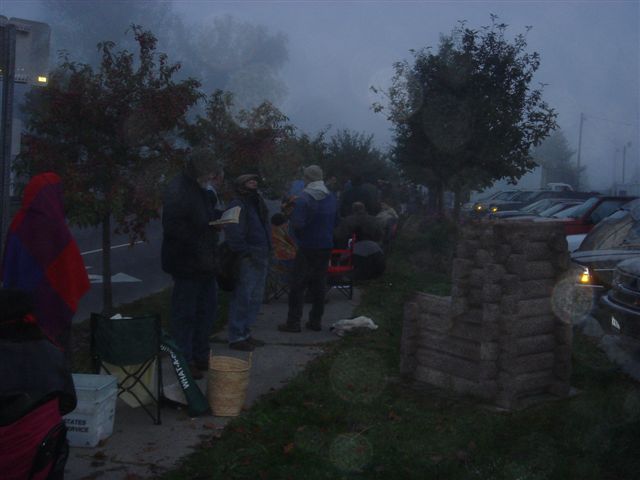
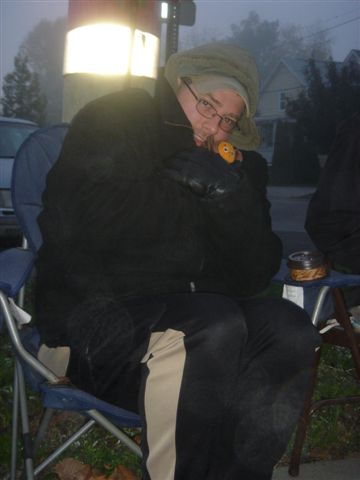
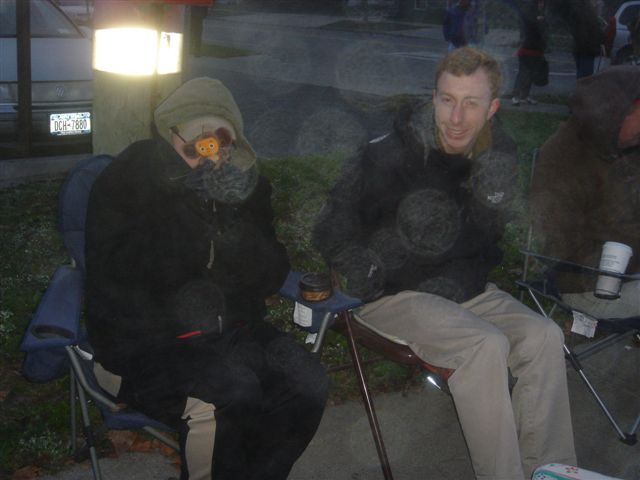
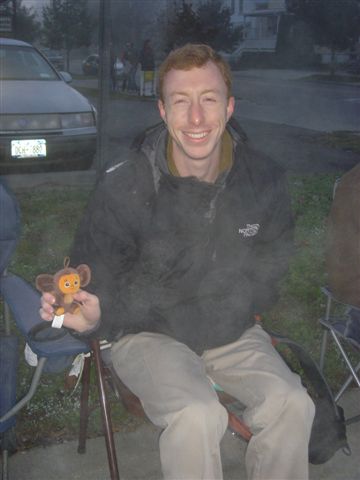
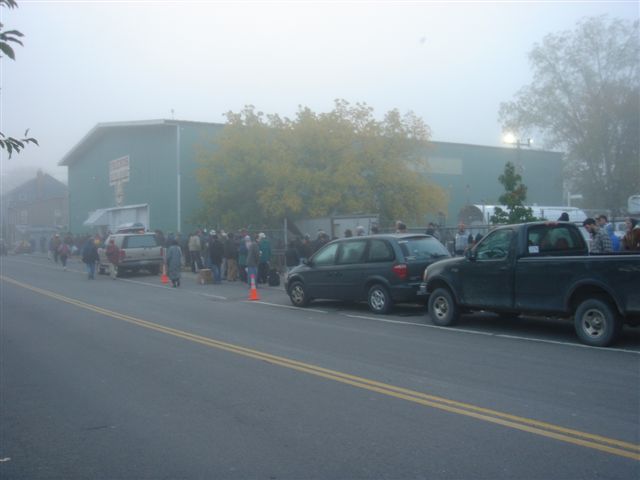
Exactly! Last Saturday, Erik, Josh and I woke up at 5:30 to go and sit in line for the Friends of the Tompkins County Public Library book sale. Apparently this is one of the largest book sales in the country and it has about 250,000 items. Basically, as I understand it, what happens is that there is an NGO which collects used books throughout the year and then sells them in a huge sale, lasting 3 weekends. It is so huge that people actually stand in line to get to the sale first. We arrived there around 6:00 and I got number 150(!). We were told that there was one guy who actually slept two days in a tent in order to be the first. So, we were relatively sane and spent only two hours on approximately 10 degrees cold sipping coffee and chatting.


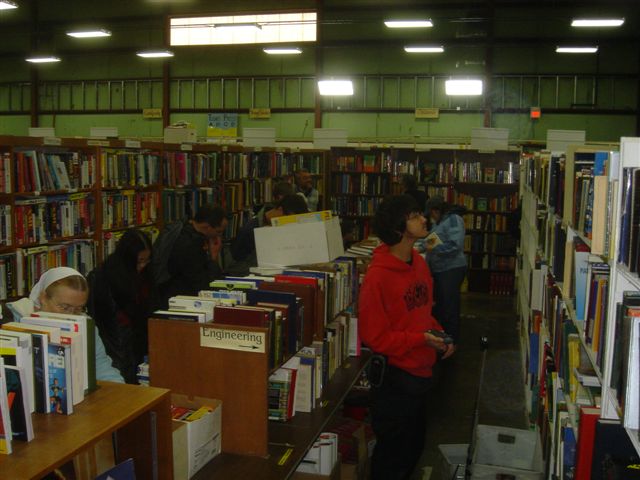
The sale itself was rather impressive. It is a huge hangar with stocks and stocks of books which are sort of organized according to topics.


I got some books. Keren would be proud of me for now I can read the actual Popper, Kuhn, Durkheim, etc. I also got Adam Smith's "Wealth of the nations"… now I have to read it all…

Thursday, September 07, 2006

Nostalgia…

Here is another interesting quotation from the stuff I am reading these days:

"William Niskanen (1971) made the simple assumption that bureau chiefs seek to maximize the budgets made available to them by legislatures. Budgets were, after all, both the symbol and measure of bureaucratic success, as well as the source of bureaucratic comfort and ease. Using its monopoly position, a bureau will attain a budget which oversupplies the bureau's output to the point at which consumer surplus is matched by the inefficiency of oversupply."

Reading that brought some memories from a certain 3-year period of my life…
-----
Full citation of the article:
Miller, Gary J. 1997. “The Impact of Economics on Political Science.” Journal of Economic Literature 35 (3): 1173‑1204

Monday, September 04, 2006

Procrastination as a statement?

I am back to school and thus read a lot of interesting stuff. Right now I am preparing for a presentation in a class called "Inside technology – social construction of technology" and am reading an article about social choice in machine design. Basically it says that mechanization of the production process in metal cutting industry "mirrors the antagonistic social relations of capitalist production".

At some point it states: "Workers practiced pacing for many reasons: to keep some time for themselves, to exercise authority over their own work, to avoid killing 'gravy' piece-rate jobs by overproducing and risking a rate cut, to stretch out available work for fear of layoffs, to exercise their creativity and ingenuity in order to 'make out' on 'stinkers (poorly rated jobs), and, of course, to express hostility to management" (I added the italic). All these are described as "collective cooperation and labor-prescribed norms of behavior".

Now I am asking myself: what about procrastination? We, as students, usually tend to procrastinate, don't we? I find the act of procrastination similar to that of pacing – postponing things without an 'objective' reason. So, when we do that, are we exercising authority over our studies or even more than that (of course) expressing our hostility to the institutions? Anyhow, it seems like procrastination can be viewed as a form of collective cooperation or kind of a norm of behavior. In other words, now, when we procrastinate, we can view it as a proletarian statement! :)

-----
In case you are interested, the full citation of the article is:
David F. Noble "Social Choice in Machine Design: The Case of Automatically Controlled Machine Tools." In MacKenzie and Wajcman (eds.) The Social Shaping of Technology. First Edition (1985), Open University Press. Second Edition (1999). Philadelphia and Milton Keynes: Open University Press.

Saturday, September 02, 2006

Beebe Lake

Last Saturday my international TA summer camp fellows, their friends and i went for a walk around one of the local attractions - the Beebe Lake. It was nice and is supposed to be even nicer later in the fall when the trees will change the color. We met some people who were jumping from a bridge to the gorge and of course the one whom i saw jumping spoke perfect Russian :)

Here are my pictures from the walk:

Walk on Beebe lake
Aug 26, 2006 - 27 Photos


Nikos has also uploaded his (despite the name he gave to his album, we didn't actually reach the plantation; just the botanic gardens).

N.B. I don't really know what the name of the lake means, but it has nothing to do with Netanyahu - that i checked :)

Friday, September 01, 2006

Wikipedia in Indian laguages

Here is another example for a reason to back Wikipedia's ideology... Isn't it cool?

Thursday, August 31, 2006

Wiki-Brittanica

So, here's a thought… (copyright Sean Brin – maybe its about a time you write something there :) I just got out of the class I am TAing on Human Computer Interaction. During the lecture, Dan, mentioned that one of the great advantages of Wikipedia is that it instantly releases material and updates; something that can hardly done by Britannica in a paper version. And I was thinking…

Britannica does have a website, so technically it could somehow adapt to the dynamics, and there is an ongoing struggle between it and Wikipedia over the online dominance (well, actually the battle has gone well beyond the borders of the cyberspace). In the last year or more, Wikipedia has been criticized for being inaccurate and mediocre, particularly compared to the established encyclopedias. Although I do favor Wikipedia's model and philosophy, today's lecture made me think that Britannica could actually have an upper hand in this online battle if it would open its mind to some new models. Thus for example I think there is place for a Wiki-Britannica: something that will have the core of Britannica content with ability for people to add and edit it. In ideal world this would be based on interaction between Britannica people and the community of Wikipedia editors, thus (hopefully) leading towards better quality, more rigorously researched, and yet more diverse and culturally sensitive content.

Here are also many questions of course. For example the question of business model arises. Today, in order to use Britannica, you have to pay, and this money is probably used to do that research the encyclopedia is so proud of. What will happen if the content will become free and dynamic online? Should all the content become free? Besides, will Britannica's content gain from a real interaction with people who care? Will the spirit of Wiki community remain if it starts interacting with an institutionalized entity such as Britannica? I don't know… but I like the idea, particularly in light of the recent changes Wikipedia had in the way the community is managed. Perhaps this is the time to consider new models for both sides of the spectrum…

We want coffee!

Well, this one is really last for today, but it is really cool and in light of the hour and the time I have to get up at the morning (7 am!!!), you can get a chance to see what I will look like.

Click here and try dragging the pot with coffee towards the dogs/bunnies/whatever they are… and there are more… (thank you Gina :)

What do I study?

Well, this is a last one for today, but it is a semi-serious one. Today we had one of those classes when we talk about defining the field of studies we all are working in. This made me wondering, how many of the people whom I know and who know me, really know what is that I am studying. Well, one thing, the previous sentence proves, is that I can't really write, but what is that I am studying? It seems that there are only two people reading my blog, but still, what do you think? :)