Showing posts with label new media. Show all posts

Thursday, May 03, 2007

The world we "live" in...

This time it is more optimistic and less realistic:
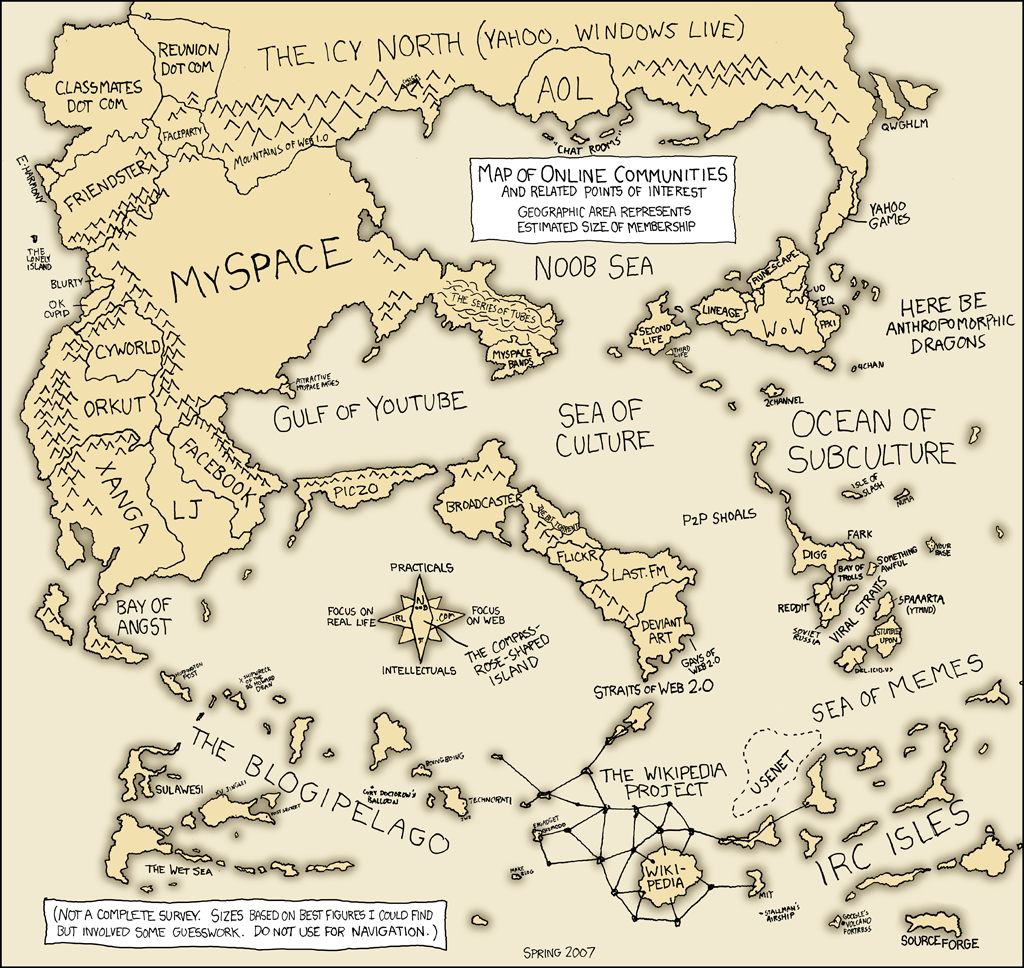

Thanks to Erik for the link. The original is at http://www.xkcd.com/

Monday, April 09, 2007

Troubles in the virtual world

There is an article telling a story of FBI going into SecondLife to investigate gambling taking place inthe virtual world. While it may be entertaining to imagine FBI agents walking around as animated creatures of opposite sex and with wings, I think it rises an interesting question about the relationship between the virtual and and the physical.

As far as i understand this, US is trying to regulate online gambling through controlling financial transactions with online casinos. But things are different for SecondLife because people there are gambling with Lindens (L$), which is the virtual money used in this world. But the issue is getting more complex since there is an entire economy associated with SeconLife and L$ are actually having a market based exchange rate with real money (L$266 = US$1 as of yesterday). So the virtual is actually real, or the other way around.

I am not sure i have enough knowledge about the phenomenon, but i think this is really fascinating. How exactly and are we going to apply regulation from the physical world to the virtual one? Not only we had to deal with concepts of identities, nationalities and geographical boundaries in virtual reality, but now we also have to address the virtual economy and its relation to the real world... Just writing this post and picking at all the statistics of economic activity there amazed me a lot. And there is much more going on there in other virtual worlds, such as WoW and other. This is simply very interesting and even fascinating.

Monday, March 05, 2007

Documentary on Google

Thanks to Tarleton for this one.

It is a bit long (47 minutes), but i think it is interesting even though i did not form a strong opinion about it. If i had to provide a short synopsis of the movie then it would be that:

- watch the first 15 minutes to see what a cool and fun company Google is
- watch the next 15 minutes to see the great scope of google's activity worldwide
- keep on watching to the next 15 minutes to hear the difficult and interesting questions google's activity rises (my favorite part).

Particularly interesting are the words of Brewster Kahle, the founder and digital librarian for the Internet Archive, reacting to the "Hole in the wall" project usage of google. If you really have no time to watch the whole thing, just listen to this around minute 37:40.


Here us a link to the page on the original website. Ironically enough it is available through google video :)

Wednesday, January 17, 2007

So much for the innovation...

Skype founders create online television service
Skype founders are Joost in time for online TV plan
Skype founders take TV to Net
Global Internet TV Service by Skype

Right now Google.news shows 278 articles (and counting) with these and similar headlines. All of them are dealing with the recent announcement of Skype founders, Niklas Zennstrm and Janus Friis, that they are going to lunch an internet based TV service they call "Joost". From my reading of a few news articles, what they are offering is to replace your TV screen with a computer screen and your decoder box provided by the cable company by software on their servers. The business model is based on advertisement (means you pay nothing exept for your time and privacy) until they offer a pay-per-view option, and they also promise the service to be piracy-proof (well, that one we'll have to wait and see).

As much as i love Skype and think it was breaking through idea at the time, right now i fail to see the great promise of Joost. Why would people like watching their TV on a computer screen? Does it mean they need to upgrade their computers to have at least 29 inch screen and a decent sound system? Does it mean the computer is moving from the office to the living room? What is the relative advantage of watching commercial based content online, vs. paying a relatively low fee and gaining full control over the content and the settings where one can view it? Today you can buy most of the content that Joost is going to offer on DVD or VoD and it doesn't cost that much (that is assuming you follow the legal way, otherwise it is even less) and you can choose where and when to watch it. One place where watching something in real time worth the effort is sports, but then again comes the question if the computer screen experience worth the $10 for the sports channel on cable? The cable companies start offering bundles of services including TV, phone and internet, so the relative part of paying for the content is probably diminishing even though it is hard to determine. Will people be willing to jeopardize their privacy even more and let also "Joost" follow what they are watching and where they are surfing? Well, the notions of privacy seems to be changing, so maybe the last question has a more obvious answer.

If Joost does go big however, one possible positive outcome from a consumers' point of view may be decrease in pricing of cable TV services. At the same, i think Microsoft's attempt to turn the x-box into a media center by connecting it to the web and actually offering the content, bares the similar, if not greater potential. Anyway, both of them are aiming at the Western, developed countries, which raises a series of additional questions about digital inclusion (divide), but that is for another post.

Even if i am mistaken in my skepticism, and Joost is going to be the next big thing (i.e. people value their privacy, time and limited ability to choose less than few dozens dollars or shekels), i still cannot get rid of the feeling that Joost is the same old thing we all know, just the cover is different (similar to the recent Google-Orange partenership). Unlike Skype that presented an innovative thinking about the technology and people's needs, Joost seems to replicate the old package and just shifting the platform. So much for the innovation...


------------------------
Update, 13:00 - Apparently i am not the only one asking these questions. Take a look here for example (and she has probably different incentives thinking about this things than i do).

Thursday, January 11, 2007

Wikipedia?

Here is an interesting post with thoughts on Wikipedia's dark future and there are three points that caught my attention.

First, the idea of commercial forces forcing their models on Wikipedia commercializing it. Basically the argument in the post is simpler and is about commercial entities taking advantage of the openness of Wiki. However, i think that it may even go beyond to a greater influence, such as that described by Schiller in his book - advertising based models taking over new media and new outlets.

Another point is about the bureaucratic structures that emerged in in Wikipedia. The interesting point is that the hierarchy in Wikipedia is activity based - those who edited more got into more powerful positions. The problem with this structure is that once the hierarchy got established, people "in power" channel they energy to preserve the power strucutre.

The thirds point is about lack of incentive for Wikipedians to continue contributing to enterprise - they are getting neither money nor recognition for their effort (which raises interesting questions regarding how they utility from contributing to Wikipedia is constructed).

The last two points made me thinking again about the potential structure we are seeking for the "Human Network". On the one hand, the idea of having a non-hierarchical structure may be workable, but there is still should be bureaucracy that will prevent people from gaining too much power that will allow them to abuse their position. It seems to me that once the main focus shifts from the core activity of an organization to preserving particular power structures, the overall performance of the organizations suffers. At the same time, the issue of incentives is important. We've seen that in the last few years dealing with HN and that is not new, but it is still good to see it shared by others.

Any additional thoughts anyone?

Wednesday, January 10, 2007

Loving Technorati

I was looking for Erik's blog in Technorati and typed the blog address (www.framingconflict.blogspot.com/) in the search field. The result exceeded all the expectations. Here you can find it and this is the text:

Huh?

There are blogs, and then there's whatever you just typed in. If it's a blog, we don't know about it. Maybe you made a typo. Or maybe it's a blog that doesn't exist. Maybe you don't exist. (In which case, please ignore this.)

I am laughing out loud :)

Thursday, January 04, 2007

Interests

A few days ago, when Saddam Husein was executed i looked what were the top topics in various online environments (it just seemed to be the only thing in most mainstream US media).

So, the top story in google.news was about Husein, as well as the top tag at technorati's web page. However, when i checked out digg.com, there was no trace of Saddam Husein's execution on the entire first page. Top stories dealt with gadgets and video games. For those who don't know, digg is a website that allows users to rate the relevance/importance of news items. Some view it as the next step in organizing the huge amounts of information we are exposed to.

Frankly, i was surprised. I just wanted to see what were the different versions of coverage of the execution, but i did not expect to find no coverage at all.

So, looking at the surprising results at digg, i thought. Is it an indication of the true priorities of web users in terms of news content? Or it is a unique feature of digg users?Or it is simply that social classification of news doesn't work?

Any thoughts?